The McKinsey Ecosystem game: complete strategy guide
In this guide
Where Ecosystem stands in 2026
Ecosystem was the best-known McKinsey Solve game for several years, which is why so much prep material still opens with it. It has now dropped out of invitations. Sources differ on when, from 2024 in some offices to around mid-2025 in most, and candidates in 2026 do not report it on any format. The full dated record is in our McKinsey Solve 2026 changes guide.
| Invitation | What you will play instead |
|---|---|
| 65 minutes | Redrock and Sea Wolf |
| 85 minutes | Redrock, Sea Wolf and the original Sustainable Futures Lab |
| 95 minutes | Redrock, Sea Wolf and the redesigned Sustainable Futures Lab |
If you are preparing now, put your time into the Redrock guide, which works an example of every stage of the study and the cases, and the Sea Wolf guide, whose trait-matching logic is the closest thing to Ecosystem's in the current line-up. The rest of this page explains how Ecosystem worked, for anyone who meets it on an older version or wants to understand the material it left behind.
Overview & objective
In the Ecosystem module you're given a pool of species: producers (plants / algae) and animals, and environmental data for each. Your job is to (1) pick a starting location and a set of producers, (2) build a matrix of species and predator–prey relationships, and (3) derive the longest viable food chain (up to 8 species) that maximizes total calories flowing through the chain.
Each species has:
- Calories provided, energy available to predators.
- Calories required, energy the species itself needs to survive (0 for producers).
- Depth/elevation range and temperature range, environmental constraints (producers only).
A predator can only eat a prey if it's listed as able to do so. The calories a prey provides minus the calories the predator requires gives the "net" energy available to the next level up.
Step 1: pick the optimal producers
Producers are grouped by their environmental range (depth/elevation + temperature). The optimal starting location is the environmental cell shared by the most producers that maximizes total calories provided. In practice: group producers with identical ranges, sum the calories in each group, and pick the group with the highest total.
Step 2: build the species matrix
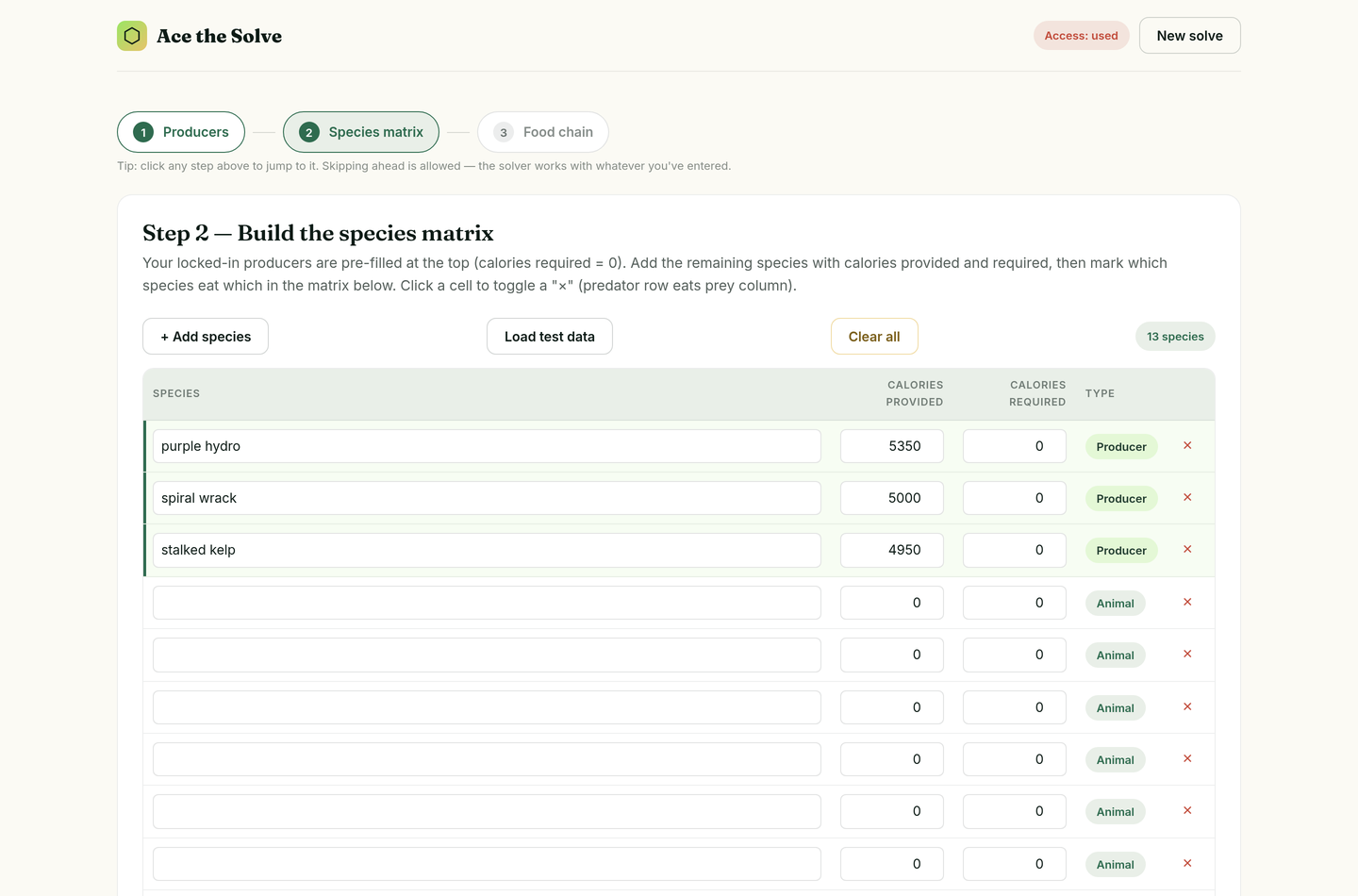
With producers locked in, you add the remaining animal species. Each animal has calories provided and calories required. You then mark which species eat which in a predator–prey matrix. A "×" in cell (row, column) means the row species eats the column species.
Constraints:
- No species eats itself.
- A predator must be able to get enough net calories from its prey to survive.
Step 3: derive the optimum food chain
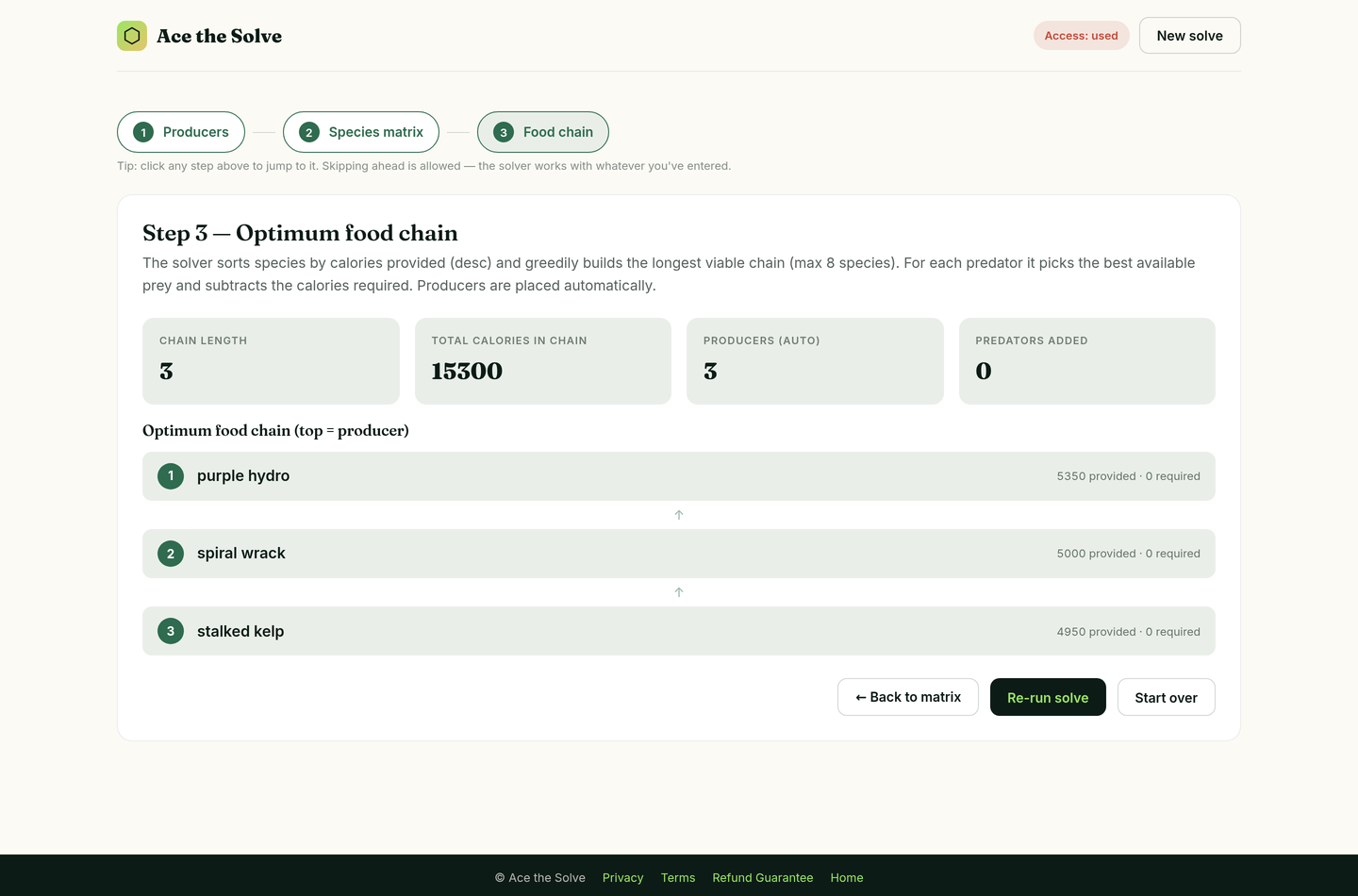
The optimum food chain is up to 8 species long, with producers at the base. The algorithm sorts species by calories provided (descending), greedily places producers, then for each predator selects the highest-calorie available prey whose remaining calories (after subtracting the predator's requirement) are still non-negative. If the best prey can't sustain the predator, it falls back to the next-best available prey.
How you're scored
- Chain length, longer is better (max 8).
- Total calories in the chain, higher is better.
- Producer set quality, did you pick the highest-calorie group?
- Move efficiency, how quickly you completed the steps.
Optimal strategy
- Always group producers by identical environment. Don't mix depth/temperature ranges, it dilutes your calorie total.
- Pick the group with the highest calorie sum, not the single highest-calorie producer.
- In the matrix, be comprehensive. Mark every true predator–prey relationship you can find, the algorithm can't use a relationship you didn't enter.
- Work fast. The selection algorithm itself is deterministic; the score-killer is time spent second-guessing.
- Balance accuracy and speed across modules. Ecosystem rewards calculation discipline; Sea Wolf rewards fast repeated decisions, which you can practise in the Sea Wolf Simulation, the Redrock Simulation and the Sustainable Futures Lab.
Sources (4)
- PrepLounge forum, "McKinsey - Solve Game" (2025): candidate and coach confirmation that Ecosystem Creation was phased out of Solve around mid-2025 and that current invitations pair Redrock Study with Sea Wolf. preplounge.com
- PrepLounge forum, "McKinsey Solve Game Preparation" (2025): coach and candidate confirmation that the Ecosystem game no longer appears in current invitations. preplounge.com
- Wall Street Oasis forum, McKinsey Solve threads: candidate accounts of the legacy Ecosystem game's scoring (calories, chain length, move efficiency) before its retirement. wallstreetoasis.com
- r/ConsultingAndFinance, McKinsey Solve threads (2024 to 2026): candidate reports on Ecosystem food-chain strategy, species selection, and scoring. reddit.com